
What AI Actually Needs to Solve in the Aging Home
Families do not need more features
Conclusion: The value of silver technology must be tested in real life: does it respect the person, reduce the family’s burden and remain reliable at the critical moment?
Begin with everyday life
AI in family care is primarily a tool for prioritising risk and coordinating information, not a diagnostician. The system must separate sensor observation, model inference, human confirmation and professional judgement, while allowing users to correct it.
The article uses “Families do not need more features” to examine product, family and service implications. Use AI first for summarisation, prioritisation and suggestions, not independent diagnosis or emergency action. High-risk output carries evidence, time, uncertainty and next action, with human override, audit and rollback.
Families do not need more features
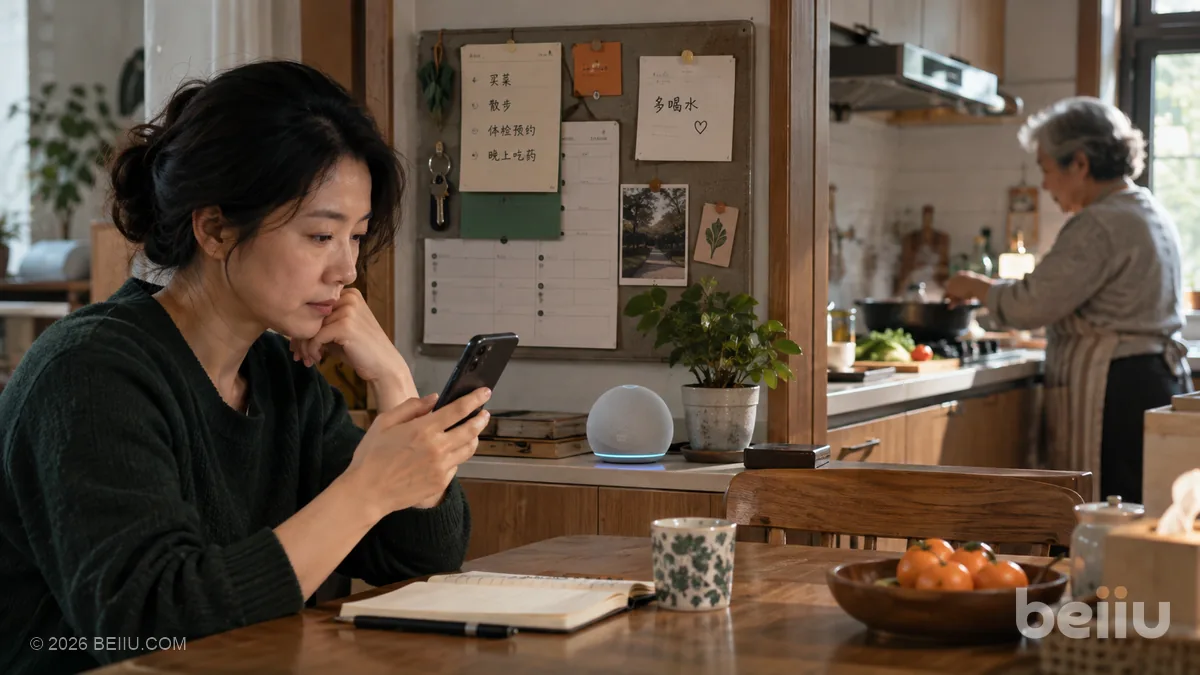
The recurring questions in family care are often simple: Did a parent get up as usual? Was medication taken? Is a device offline? Was there unusual activity at night? Will the right person know when help may be needed? If AI adds conversation and entertainment but does not improve these essential workflows, its value is limited. The aging home needs systems that are understandable, confirmable and accountable, not merely a more impressive model.
To turn “Families do not need more features” into a reviewable judgment, separate sensor fact, rule trigger, model probability, human confirmation and professional judgement in interfaces and logs, with a correction path. When evaluating “Families do not need more features”, use alerts entering human review as the denominator and report actionable alerts, false alarms, misses, indeterminate cases and confirmed no-action cases, and if field evidence contradicts “Families do not need more features”, narrow the scope and amend requirements rather than removing the counterexample.
Find meaningful exceptions in noisy data
A night-time trip to the bathroom may be routine or may indicate discomfort. A period of stillness may be rest or a reason to check in. AI should combine time, trends, device status and an authorised personal baseline to rank anomalies instead of forwarding every change. Frequent false alarms quickly erode trust. A useful system explains what changed, why it raised an alert and what to do first. It should also learn from confirmed outcomes without hiding its limitations.
To turn “Find meaningful exceptions in noisy data” into a reviewable judgment, explain anomalies against personal baseline and recent change while showing device state, missing data and uncertainty rather than one isolated risk score. When evaluating “Find meaningful exceptions in noisy data”, measure whether explanation was seen, could be restated, supported the right action and created over-reliance, and if field evidence contradicts “Families do not need more features”, narrow the scope and amend requirements rather than removing the counterexample.
Reduce effort for both generations
The older adult needs few steps, low memory load and clear feedback. Adult children need a status they can understand at a glance, not a wall of measurements. AI can turn complex settings into natural language, consolidate device data into daily summaries and prioritise genuine risk. Automation must preserve human control. Health interpretation, emergency contacts and privacy permissions require explicit boundaries. Automated assessments should support, not replace, decisions by families and professionals.
To turn “Reduce effort for both generations” into a reviewable judgment, set automation limits, takeover deadlines, escalation owners, withdrawal rights and rollback by risk level and model version. When evaluating “Reduce effort for both generations”, monitor drift, human override, takeover completion and high-consequence error by model, rule, data source and population slice, and if field evidence contradicts “Families do not need more features”, narrow the scope and amend requirements rather than removing the counterexample.
Close the loop from detection to response
Detection is only the beginning. Someone must confirm the event, contact the appropriate person, respond and record the outcome. AI should help route information to relatives, carers or service organisations and make completion visible. The core is therefore not an isolated model but a sensing, assessment, notification and response loop. Its performance should be judged by false-alarm rate, response time, user understanding, privacy protection and sustained use.
To turn “Close the loop from detection to response” into a reviewable judgment, separate sensor fact, rule trigger, model probability, human confirmation and professional judgement in interfaces and logs, with a correction path. When evaluating “Close the loop from detection to response”, use alerts entering human review as the denominator and report actionable alerts, false alarms, misses, indeterminate cases and confirmed no-action cases, and if field evidence contradicts “Families do not need more features”, narrow the scope and amend requirements rather than removing the counterexample.
Place the argument between public evidence and counterexamples
When a system flags unusual activity, the family needs the trigger time, device state, deviation from the person’s baseline and a suggested confirmation action, not an unexplained risk score. Stronger automation requires clearer human takeover, audit trails and stop controls.
- National People’s Congress: Personal Information Protection Law of the People’s Republic of China ↗
- General Office of the State Council: Plan to Address Barriers Older People Face in Using Smart Technologies ↗
- World Health Organization: Integrated care for older people (ICOPE) ↗
- ISO: ISO 25550 Framework for Smart Multigenerational Neighbourhoods ↗
Together, these sources form the factual and methodological basis of the article. BEIIU considers regulation, public-health frameworks, design standards and real-world settings separately rather than asking one source to carry the whole conclusion.
Conditions that would overturn the thesis
- 01
presenting probability as certainty
- 02
retaining data indefinitely for unspecified future use
- 03
providing no human takeover when models fail
- 04
optimising model metrics while ignoring response outcomes
Disable the automation when sources are untraceable, fabrication or drift recurs, takeover is nominal, people read probability as diagnosis, or high-consequence error cannot be controlled. Counterexamples belong in the argument and product decision, not only in a disclaimer.
Judge outcomes rather than feature count
- 01 · actionable alert rate
For “actionable alert rate”, use alerts entering human review as the denominator and report actionable alerts, false alarms, misses, indeterminate cases and confirmed no-action cases. The “actionable alert rate” record also retains the period, version, incomplete and exception cases so an average cannot become an outcome claim detached from context.
- 02 · human takeover completion
For “human takeover completion”, measure whether explanation was seen, could be restated, supported the right action and created over-reliance. The “human takeover completion” record also retains the period, version, incomplete and exception cases so an average cannot become an outcome claim detached from context.
- 03 · device and data availability
For “device and data availability”, monitor drift, human override, takeover completion and high-consequence error by model, rule, data source and population slice. The “device and data availability” record also retains the period, version, incomplete and exception cases so an average cannot become an outcome claim detached from context.
- 04 · comprehension and withdrawal
For “comprehension and withdrawal”, use alerts entering human review as the denominator and report actionable alerts, false alarms, misses, indeterminate cases and confirmed no-action cases. The “comprehension and withdrawal” record also retains the period, version, incomplete and exception cases so an average cannot become an outcome claim detached from context.
BEIIU / 辈佑 focuses on whether technology genuinely improves everyday life for older adults, reduces family burden and supports a clear response when it matters.
Turn research into better choices
Families can begin with the one task that most affects everyday life, then clarify who uses the solution, who supports it and who responds when something changes. Institutions and industry partners must also account for workflow, maintenance, privacy and lifecycle cost. A precise problem definition is often more valuable than adding another feature.
BEIIU / 辈佑 continues to connect public evidence, scenario observation and user feedback so research can support product judgment, partnership conversations and family decisions.
References
Prepared by the BEIIU Insights editorial team from public sources to help families and industry partners understand relevant trends, product methods and application boundaries.
- 01National People’s Congress: Personal Information Protection Law of the People’s Republic of China ↗
Supports analysis of purpose limitation, necessity, consent, sensitive information and individual rights.
- 02General Office of the State Council: Plan to Address Barriers Older People Face in Using Smart Technologies ↗
Supports maintaining workable alternatives and improving access in high-frequency public and daily-life services.
- 03World Health Organization: Integrated care for older people (ICOPE) ↗
Supports person-centred assessment, continuity of care and integrated community-level services.
- 04ISO: ISO 25550 Framework for Smart Multigenerational Neighbourhoods ↗
Supports evaluating products within neighbourhoods, public space, services and multigenerational relationships.