
Why Fall Detection Cannot Rely on Wearables Alone
Wearables have value and inherent limits
Conclusion: The value of silver technology must be tested in real life: does it respect the person, reduce the family’s burden and remain reliable at the critical moment?
Begin with everyday life
Home safety spans prevention, event detection and response. Environment, functional ability, medication, behaviour, device health and available responders jointly determine the outcome; detection is only one layer.
The article uses “Wearables have value and inherent limits” to examine product, family and service implications. Validate the whole incident chain. Remove directly remediable environmental hazards before testing sensing and response; use redundant signals and human confirmation for high-consequence contexts, with a help path during system outage.
Wearables have value and inherent limits
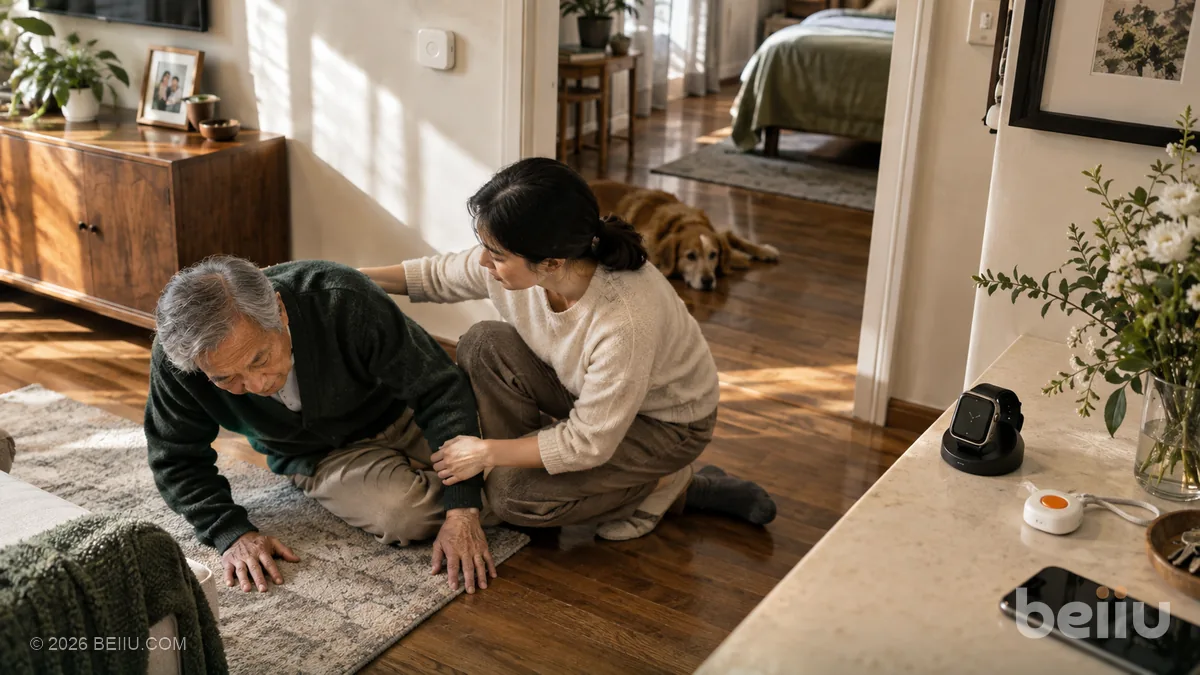
Watches and personal alarms can combine motion data, posture change and manual activation, while also providing location outdoors. They are an important part of a guardian system. Their effectiveness depends on being worn correctly, charged and connected. Bathing, sleeping and relaxing at home are precisely when a device may be removed, yet falls still occur. A person experiencing cognitive impairment or sudden loss of consciousness may also be unable to press SOS.
To turn “Wearables have value and inherent limits” into a reviewable judgment, inspect flooring, lighting, support, footwear, medication, function and help access across getting up, transfer, walking, toileting and return. When evaluating “Wearables have value and inherent limits”, report coverage by room, posture, occlusion and relevant environmental condition instead of hiding high-risk blind spots in a home-wide average, and if field evidence contradicts “Wearables have value and inherent limits”, narrow the scope and amend requirements rather than removing the counterexample.
No single detection method covers every fall
A hard impact, a slow slide, a fall from a bed and a collapse can produce very different signals. A single threshold may miss a gradual fall or mistake sitting down quickly for an emergency. More robust detection combines motion speed, posture, centre-of-mass height, inactivity after the event and the surrounding space. Responsible providers should state performance boundaries and avoid claims of perfect detection.
To turn “No single detection method covers every fall” into a reviewable judgment, design prevention, detection, confirmation, arrival, action and review separately because device accuracy cannot compensate for a missing stage. When evaluating “No single detection method covers every fall”, report misses, false alarms, indeterminate output and unavailability together and weight them by consequence rather than count alone, and if field evidence contradicts “Wearables have value and inherent limits”, narrow the scope and amend requirements rather than removing the counterexample.
Ambient sensing fills indoor gaps
Non-visual sensors such as millimetre-wave radar can observe movement and posture in fixed spaces without requiring a wearable or capturing identifiable images. They can provide a second layer in bedrooms, bathrooms and care facilities. Ambient sensing also has limits. Room layout, multiple occupants, obstruction, installation position and model generalisation all affect results. Each deployment requires scenario testing and a process for confirming alerts.
To turn “Ambient sensing fills indoor gaps” into a reviewable judgment, rehearse routine movement, near miss, simulated event, real anomaly, network loss and power loss while recording whether manual fallback continues. When evaluating “Ambient sensing fills indoor gaps”, timestamp occurrence, detection, confirmation, responder arrival and completed action while retaining incidents that never close, and if field evidence contradicts “Wearables have value and inherent limits”, narrow the scope and amend requirements rather than removing the counterexample.
Reliability comes from layered protection
A stronger architecture uses wearables for mobility and personal status, ambient sensors in critical rooms, emergency buttons for active calls, and family or institutional applications for confirmation and response. These layers complement rather than replace one another. The outcome depends on false-alarm control, confirmation time, escalation rules and continuous device-status monitoring. The response loop matters more than any single sensor specification. Note This article discusses product and scenario design. Fall-detection products do not replace medical diagnosis, professional care or emergency services.
To turn “Reliability comes from layered protection” into a reviewable judgment, inspect flooring, lighting, support, footwear, medication, function and help access across getting up, transfer, walking, toileting and return. When evaluating “Reliability comes from layered protection”, report coverage by room, posture, occlusion and relevant environmental condition instead of hiding high-risk blind spots in a home-wide average, and if field evidence contradicts “Wearables have value and inherent limits”, narrow the scope and amend requirements rather than removing the counterexample.
Place the argument between public evidence and counterexamples
A night-time bathroom trip links lighting, transfer stability, flooring, grab support, path width, sensing coverage and responder availability. Adding an alarm cannot compensate for an unsafe environment or an absent response pathway.
- World Health Organization: Falls ↗
- World Health Organization: Ageing and health ↗
- State Administration for Market Regulation: GB/T 45272-2025 Guidelines for Age-Friendly Home Product Design ↗
- World Health Organization: Integrated care for older people (ICOPE) ↗
Together, these sources form the factual and methodological basis of the article. BEIIU considers regulation, public-health frameworks, design standards and real-world settings separately rather than asking one source to carry the whole conclusion.
Conditions that would overturn the thesis
- 01
reporting aggregate accuracy without conditions
- 02
ignoring power, network and occlusion failures
- 03
creating enough false alarms that families disable alerts
- 04
failing to rehearse confirmation and rescue
Pause and redefine the context when false alarms make users disable the system, misses cluster in the target high-risk setting, nobody can respond in time, or the intervention suppresses necessary activity. Counterexamples belong in the argument and product decision, not only in a disclaimer.
Judge outcomes rather than feature count
- 01 · event detection
For “event detection”, report coverage by room, posture, occlusion and relevant environmental condition instead of hiding high-risk blind spots in a home-wide average. The “event detection” record also retains the period, version, incomplete and exception cases so an average cannot become an outcome claim detached from context.
- 02 · confirmation time
For “confirmation time”, report misses, false alarms, indeterminate output and unavailability together and weight them by consequence rather than count alone. The “confirmation time” record also retains the period, version, incomplete and exception cases so an average cannot become an outcome claim detached from context.
- 03 · false alarms and misses
For “false alarms and misses”, timestamp occurrence, detection, confirmation, responder arrival and completed action while retaining incidents that never close. The “false alarms and misses” record also retains the period, version, incomplete and exception cases so an average cannot become an outcome claim detached from context.
- 04 · response completion
For “response completion”, report coverage by room, posture, occlusion and relevant environmental condition instead of hiding high-risk blind spots in a home-wide average. The “response completion” record also retains the period, version, incomplete and exception cases so an average cannot become an outcome claim detached from context.
BEIIU / 辈佑 focuses on whether technology genuinely improves everyday life for older adults, reduces family burden and supports a clear response when it matters.
Turn research into better choices
Families can begin with the one task that most affects everyday life, then clarify who uses the solution, who supports it and who responds when something changes. Institutions and industry partners must also account for workflow, maintenance, privacy and lifecycle cost. A precise problem definition is often more valuable than adding another feature.
BEIIU / 辈佑 continues to connect public evidence, scenario observation and user feedback so research can support product judgment, partnership conversations and family decisions.
References
Prepared by the BEIIU Insights editorial team from public sources to help families and industry partners understand relevant trends, product methods and application boundaries.
- 01World Health Organization: Falls ↗
Supports treating falls as a multifactorial risk rather than a problem solved by one detection device.
- 02World Health Organization: Ageing and health ↗
Supports the healthy-ageing framework, including functional ability and the interaction between intrinsic capacity and environment.
- 03State Administration for Market Regulation: GB/T 45272-2025 Guidelines for Age-Friendly Home Product Design ↗
Supports a multidimensional view of age-friendly home products covering safety, usability, comfort, intelligence and health.
- 04World Health Organization: Integrated care for older people (ICOPE) ↗
Supports person-centred assessment, continuity of care and integrated community-level services.