
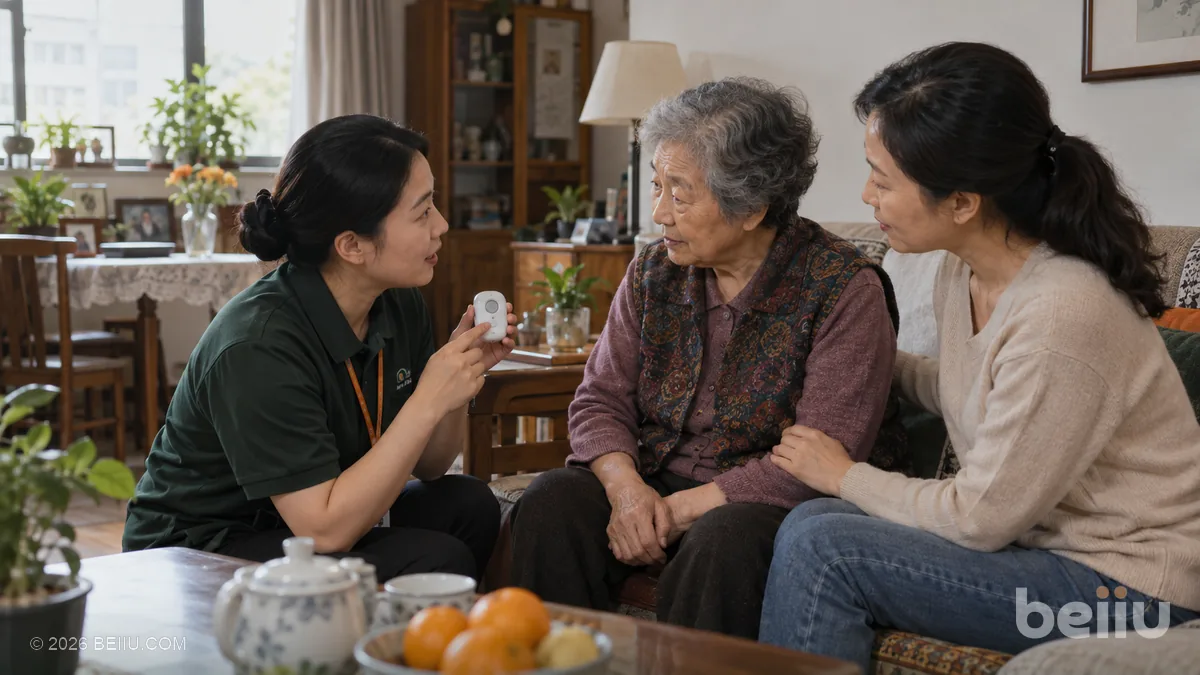
Key Considerations When Communicating Products with Older Adults Experiencing Cognitive Changes
Safety solutions require understanding and as full participation as possible
Conclusion: Explain purposes using simple, concrete life scenarios and respect expression and choice
Define the decision before discussing the solution
Cognitive change can affect memory, orientation, judgement and communication, but not uniformly. Products should preserve familiar cues, reduce choice burden, support ongoing consent and connect location or reminders to real people and services.
Explaining only to children or installing devices without the older adult's involvement can create distrust and refusal to use
“Safety solutions require understanding and as full participation as possible” must be decomposed into population, life task, operating condition and observable result. “Explain only one task at a time” fixes the problem and inputs, “Use familiar terminology” tests entry into real workflow, and “Invite the older adult to participate in setup” tests whether the conclusion survives contextual change; for “Safety solutions require understanding and as full participation as possible”, without all three, technical capability, service accountability and partnership scope cannot be compared.
Three actions form one operating chain
Explain only one task at a time
Acceptance of “Explain only one task at a time” requires function, comprehension, completed action and recovery. The operating method is to build a dynamic baseline from familiar routes, activity times and personal routine while separating location drift, detours and genuine anomaly, then compare “Understanding repetition rate” at baseline, after change and during system unavailability.
Use familiar terminology
For “Use familiar terminology”, use short, familiar, single-task cues and renew the person’s choice whenever capacity allows rather than treating one consent as permanent. The record also names the trigger, operator, input, completion evidence and exception takeover, then uses “Reasons for refusal” to check whether burden merely moved to the older person, family or frontline staff.
Invite the older adult to participate in setup
Validate “Invite the older adult to participate in setup” through a bounded change: predefine phone confirmation, neighbour support, community contact, offline search and professional referral because a location point is not a recovery process. An improved average is insufficient without exceptions, non-completion and manual recovery, and the next step, “Explain only one task at a time”, retains the same population and definitions.
These actions are not parallel recommendations. “Explain only one task at a time” tests the problem definition, “Use familiar terminology” tests entry into real work, and “Invite the older adult to participate in setup” tests whether the result can be reviewed and sustained; removing “Invite the older adult to participate in setup” makes this article confuse contextual evidence with general effectiveness.
Return the argument to one real use episode
A geofence based on one fixed circle can classify a routine walk, a detour and location drift as the same anomaly. A safer approach learns the person’s activity pattern and agrees confirmation rules for time, area and duration.
Cognitive support preserves familiarity and choice. Rules begin with the person’s real life-space and change with ability and preference; every restriction needs purpose, duration, reviewer and a less restrictive alternative.
This article uses “Explain only one task at a time” as the minimum task and “Understanding repetition rate” across routine, exception, refusal and unavailable cases. In evaluating “Safety solutions require understanding and as full participation as possible”, requirements, product, connectivity, interaction, response and ownership failures remain separate rather than hidden in an average.
“Explain purposes using simple, concrete life scenarios and respect expression and choice” supports scaling only when it continues through routine use and exception cases.
Every metric needs a denominator and context
- Understanding repetition rate
For “Understanding repetition rate”, report geofence triggers, location drift, human confirmation, genuine anomaly and unresolved events by time and area rule. Retain the population, baseline, period, version and exception handling so the measure tests whether “Explain only one task at a time” improved a real task rather than becoming a context-free promotional number.
- Reasons for refusal
For “Reasons for refusal”, observe participation, refusal, anxiety, life-space and social participation rather than measuring only absence of wandering. Retain the population, baseline, period, version and exception handling so the measure tests whether “Use familiar terminology” improved a real task rather than becoming a context-free promotional number.
- Number of proactive help requests
For “Number of proactive help requests”, record family and service search time, unnecessary action, permission changes and incident-review completeness. Retain the population, baseline, period, version and exception handling so the measure tests whether “Invite the older adult to participate in setup” improved a real task rather than becoming a context-free promotional number.
For “Understanding repetition rate, Reasons for refusal, Number of proactive help requests” describe different layers of demand, process and outcome and cannot collapse into one score. Safety analysis around “Understanding repetition rate” includes misses, false alarms, unavailability and manual recovery; service analysis around “Reasons for refusal” includes waiting, non-completion and recipient experience.
Plausible ideas can still produce the wrong system
- 01
expanding monitoring forever after one consent event
- 02
providing location without an offline search process
- 03
substituting childish interfaces for cognitive support
- 04
turning family stress into excessive restriction
Reduce or exit when ordinary activity is persistently classified as danger, restrictions materially shrink life, the person repeatedly refuses, offline response is absent, or proxy authority is no longer reviewed.
For “Use familiar terminology”, pause, human takeover, retest, exit and data deletion belong inside the product definition rather than a note written after failure.
The same system gives different roles different duties
- 01
the person continues to participate whenever capacity allows
- 02
family members record why rules change
- 03
community and professionals join only under explicit conditions
For “Safety solutions require understanding and as full participation as possible”, “the family will monitor it” is not an operating model. Around “Use familiar terminology”, name who receives information, confirms anomalies, handles emergencies, maintains equipment and changes rules; “Reasons for refusal” without an owner or response time is not a service.
Use bounded validation instead of a large one-off rollout
For “Safety solutions require understanding and as full participation as possible”, define the population and task, capture a baseline, agree data and consent boundaries, introduce a bounded change, record routine and failure cases, and use “Understanding repetition rate, Reasons for refusal, Number of proactive help requests” to continue, modify or stop. Every “Invite the older adult to participate in setup” step retains its version and owner.
Before scaling “Invite the older adult to participate in setup”, test whether value came from the intervention rather than extra labour, whether outcomes repeat across households or shifts, and whether maintenance, training and human takeover are budgeted; an unanswered “Number of proactive help requests” keeps “Explain purposes using simple, concrete life scenarios and respect expression and choice” narrow.
Professional judgement is explicit about uncertainty
BEIIU approaches “Safety solutions require understanding and as full participation as possible” through a testable task: Explain purposes using simple, concrete life scenarios and respect expression and choice Around “Explain only one task at a time”, the brand owns method and accountability rather than substituting its name for evidence, and keeps facts, findings, hypotheses and intentions separate.
The framework for “Safety solutions require understanding and as full participation as possible” does not replace individual medical, care, legal or procurement assessment. Deployment of “Use familiar terminology” still reviews functional ability, housing, local service capacity, regulation and personal choice.
What a reviewable project memorandum should contain
For “Safety solutions require understanding and as full participation as possible”, begin with the original problem and current alternative rather than a predetermined product, then record who owns “Explain only one task at a time, Use familiar terminology, Invite the older adult to participate in setup”, its conditions and when it should not occur so failure can be located in needs, design, installation, service or accountability.
The evidence chain for “Explain purposes using simple, concrete life scenarios and respect expression and choice” separates interview statements from interpretation, device observations from model inference, and pilot outcomes from future targets. For “Understanding repetition rate, Reasons for refusal, Number of proactive help requests”, retain denominator, period, attrition, version change and exception handling so incomplete cases remain visible.
A cognitive-support record retains the person’s continued participation, familiar activity range, reasons for rule changes, location drift and the offline search process. One consent event cannot cover new data uses indefinitely; changing ability, household or routine requires renewed explanation and choice.
A review of “Safety solutions require understanding and as full participation as possible” places “Explain only one task at a time” and “Understanding repetition rate” in one evidence chain: the former states what changed and the latter how it was observed, and when they do not connect, improvement in “Understanding repetition rate” does not establish improvement in “Explain only one task at a time”.
For “Invite the older adult to participate in setup”, define continuation, modification and stop conditions, including safety, privacy, acceptance or maintenance risks that trigger a manual path, so a later team can reconstruct the judgment behind “Explain purposes using simple, concrete life scenarios and respect expression and choice”.
Evidence base and use
The following sources establish policy, healthy-ageing, design, privacy or care boundaries for the topic; they do not validate a specific product by themselves.
- 01World Health Organization: Integrated care for older people (ICOPE) ↗
Supports person-centred assessment, continuity of care and integrated community-level services.
- 02World Health Organization: Ageing and health ↗
Supports the healthy-ageing framework, including functional ability and the interaction between intrinsic capacity and environment.
- 03National People’s Congress: Personal Information Protection Law of the People’s Republic of China ↗
Supports analysis of purpose limitation, necessity, consent, sensitive information and individual rights.
- 04ISO: ISO 25550 Framework for Smart Multigenerational Neighbourhoods ↗
Supports evaluating products within neighbourhoods, public space, services and multigenerational relationships.