
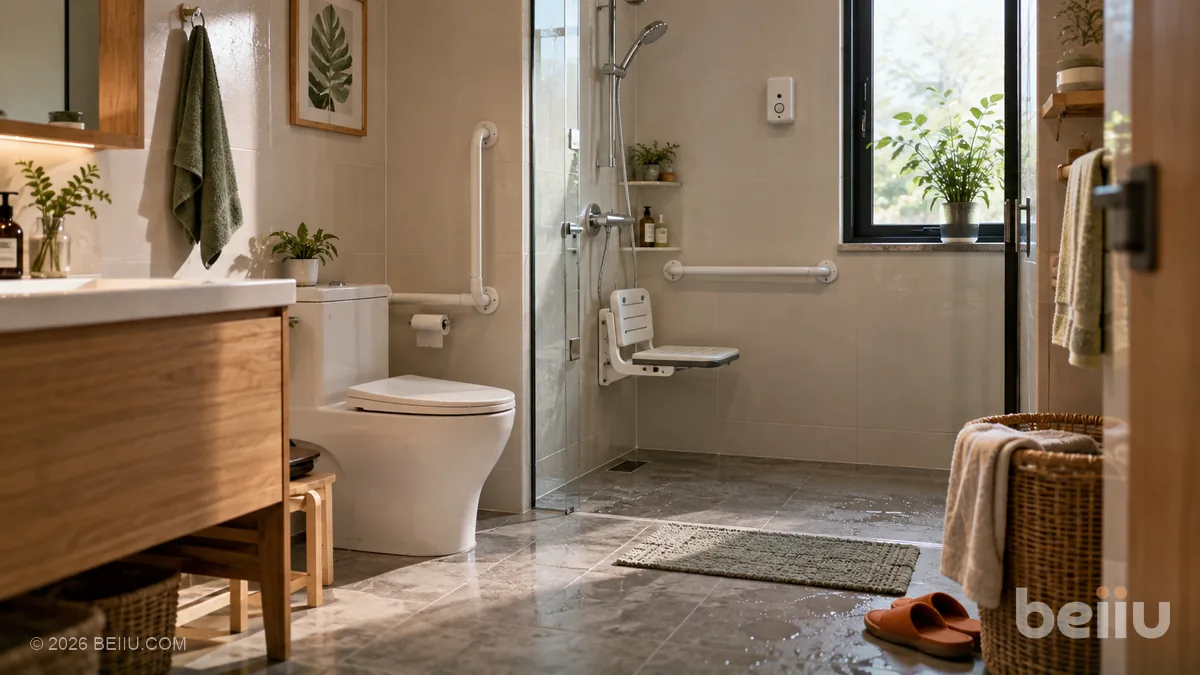
What to focus on for bathroom fall protection
Select appropriate technology that balances high-risk mitigation with privacy needs
Conclusion: Prioritize improvements to slip resistance, grab bars, and lighting before evaluating non-visual sensing and abnormal dwell time alerts
Define the decision before discussing the solution
Home safety spans prevention, event detection and response. Environment, functional ability, medication, behaviour, device health and available responders jointly determine the outcome; detection is only one layer.
Bathrooms present a challenging environment due to slippery surfaces, complex movements, and numerous obstructions; they are also unsuitable for cameras, making them one of the most difficult spaces for home safety design
“Select appropriate technology that balances high-risk mitigation with privacy needs” must be decomposed into population, life task, operating condition and observable result. “Implement environmental modifications first” fixes the problem and inputs, “Assess coverage installation” tests entry into real workflow, and “Define methods for human verification” tests whether the conclusion survives contextual change; for “Select appropriate technology that balances high-risk mitigation with privacy needs”, without all three, technical capability, service accountability and partnership scope cannot be compared.
Three actions form one operating chain
Implement environmental modifications first
For “Implement environmental modifications first”, inspect flooring, lighting, support, footwear, medication, function and help access across getting up, transfer, walking, toileting and return. The record also names the trigger, operator, input, completion evidence and exception takeover, then uses “Number of blind spots” to check whether burden merely moved to the older person, family or frontline staff.
Assess coverage installation
Validate “Assess coverage installation” through a bounded change: design prevention, detection, confirmation, arrival, action and review separately because device accuracy cannot compensate for a missing stage. An improved average is insufficient without exceptions, non-completion and manual recovery, and the next step, “Define methods for human verification”, retains the same population and definitions.
Define methods for human verification
Acceptance of “Define methods for human verification” requires function, comprehension, completed action and recovery. The operating method is to rehearse routine movement, near miss, simulated event, real anomaly, network loss and power loss while recording whether manual fallback continues, then compare “Response accessibility” at baseline, after change and during system unavailability.
These actions are not parallel recommendations. “Implement environmental modifications first” tests the problem definition, “Assess coverage installation” tests entry into real work, and “Define methods for human verification” tests whether the result can be reviewed and sustained; removing “Define methods for human verification” makes this article confuse contextual evidence with general effectiveness.
Return the argument to one real use episode
A night-time bathroom trip links lighting, transfer stability, flooring, grab support, path width, sensing coverage and responder availability. Adding an alarm cannot compensate for an unsafe environment or an absent response pathway.
Validate the whole incident chain. Remove directly remediable environmental hazards before testing sensing and response; use redundant signals and human confirmation for high-consequence contexts, with a help path during system outage.
This article uses “Implement environmental modifications first” as the minimum task and “Number of blind spots” across routine, exception, refusal and unavailable cases. In evaluating “Select appropriate technology that balances high-risk mitigation with privacy needs”, requirements, product, connectivity, interaction, response and ownership failures remain separate rather than hidden in an average.
“Prioritize improvements to slip resistance, grab bars, and lighting before evaluating non-visual sensing and abnormal dwell time alerts” supports scaling only when it continues through routine use and exception cases.
Every metric needs a denominator and context
- Number of blind spots
For “Number of blind spots”, report coverage by room, posture, occlusion and relevant environmental condition instead of hiding high-risk blind spots in a home-wide average. Retain the population, baseline, period, version and exception handling so the measure tests whether “Implement environmental modifications first” improved a real task rather than becoming a context-free promotional number.
- Types of false alarms
For “Types of false alarms”, report misses, false alarms, indeterminate output and unavailability together and weight them by consequence rather than count alone. Retain the population, baseline, period, version and exception handling so the measure tests whether “Assess coverage installation” improved a real task rather than becoming a context-free promotional number.
- Response accessibility
For “Response accessibility”, timestamp occurrence, detection, confirmation, responder arrival and completed action while retaining incidents that never close. Retain the population, baseline, period, version and exception handling so the measure tests whether “Define methods for human verification” improved a real task rather than becoming a context-free promotional number.
For “Number of blind spots, Types of false alarms, Response accessibility” describe different layers of demand, process and outcome and cannot collapse into one score. Safety analysis around “Number of blind spots” includes misses, false alarms, unavailability and manual recovery; service analysis around “Types of false alarms” includes waiting, non-completion and recipient experience.
Plausible ideas can still produce the wrong system
- 01
reporting aggregate accuracy without conditions
- 02
ignoring power, network and occlusion failures
- 03
creating enough false alarms that families disable alerts
- 04
failing to rehearse confirmation and rescue
Pause and redefine the context when false alarms make users disable the system, misses cluster in the target high-risk setting, nobody can respond in time, or the intervention suppresses necessary activity.
For “Assess coverage installation”, pause, human takeover, retest, exit and data deletion belong inside the product definition rather than a note written after failure.
The same system gives different roles different duties
- 01
older people help set the balance between risk and autonomy
- 02
families know which conditions require immediate action
- 03
providers disclose fallback paths when technology fails
For “Select appropriate technology that balances high-risk mitigation with privacy needs”, “the family will monitor it” is not an operating model. Around “Assess coverage installation”, name who receives information, confirms anomalies, handles emergencies, maintains equipment and changes rules; “Types of false alarms” without an owner or response time is not a service.
Use bounded validation instead of a large one-off rollout
For “Select appropriate technology that balances high-risk mitigation with privacy needs”, define the population and task, capture a baseline, agree data and consent boundaries, introduce a bounded change, record routine and failure cases, and use “Number of blind spots, Types of false alarms, Response accessibility” to continue, modify or stop. Every “Define methods for human verification” step retains its version and owner.
Before scaling “Define methods for human verification”, test whether value came from the intervention rather than extra labour, whether outcomes repeat across households or shifts, and whether maintenance, training and human takeover are budgeted; an unanswered “Response accessibility” keeps “Prioritize improvements to slip resistance, grab bars, and lighting before evaluating non-visual sensing and abnormal dwell time alerts” narrow.
Professional judgement is explicit about uncertainty
BEIIU approaches “Select appropriate technology that balances high-risk mitigation with privacy needs” through a testable task: Prioritize improvements to slip resistance, grab bars, and lighting before evaluating non-visual sensing and abnormal dwell time alerts Around “Implement environmental modifications first”, the brand owns method and accountability rather than substituting its name for evidence, and keeps facts, findings, hypotheses and intentions separate.
The framework for “Select appropriate technology that balances high-risk mitigation with privacy needs” does not replace individual medical, care, legal or procurement assessment. Deployment of “Assess coverage installation” still reviews functional ability, housing, local service capacity, regulation and personal choice.
What a reviewable project memorandum should contain
For “Select appropriate technology that balances high-risk mitigation with privacy needs”, begin with the original problem and current alternative rather than a predetermined product, then record who owns “Implement environmental modifications first, Assess coverage installation, Define methods for human verification”, its conditions and when it should not occur so failure can be located in needs, design, installation, service or accountability.
The evidence chain for “Prioritize improvements to slip resistance, grab bars, and lighting before evaluating non-visual sensing and abnormal dwell time alerts” separates interview statements from interpretation, device observations from model inference, and pilot outcomes from future targets. For “Number of blind spots, Types of false alarms, Response accessibility”, retain denominator, period, attrition, version change and exception handling so incomplete cases remain visible.
A safety record includes near misses, environmental change, unavailable equipment and manual recovery, not only completed incidents. Low-frequency, high-consequence events such as falls need separate detection, confirmation, arrival and follow-up timestamps so an alert is not mistaken for risk closure.
A review of “Select appropriate technology that balances high-risk mitigation with privacy needs” places “Implement environmental modifications first” and “Number of blind spots” in one evidence chain: the former states what changed and the latter how it was observed, and when they do not connect, improvement in “Number of blind spots” does not establish improvement in “Implement environmental modifications first”.
For “Define methods for human verification”, define continuation, modification and stop conditions, including safety, privacy, acceptance or maintenance risks that trigger a manual path, so a later team can reconstruct the judgment behind “Prioritize improvements to slip resistance, grab bars, and lighting before evaluating non-visual sensing and abnormal dwell time alerts”.
Evidence base and use
The following sources establish policy, healthy-ageing, design, privacy or care boundaries for the topic; they do not validate a specific product by themselves.
- 01World Health Organization: Falls ↗
Supports treating falls as a multifactorial risk rather than a problem solved by one detection device.
- 02World Health Organization: Ageing and health ↗
Supports the healthy-ageing framework, including functional ability and the interaction between intrinsic capacity and environment.
- 03State Administration for Market Regulation: GB/T 45272-2025 Guidelines for Age-Friendly Home Product Design ↗
Supports a multidimensional view of age-friendly home products covering safety, usability, comfort, intelligence and health.
- 04World Health Organization: Integrated care for older people (ICOPE) ↗
Supports person-centred assessment, continuity of care and integrated community-level services.