
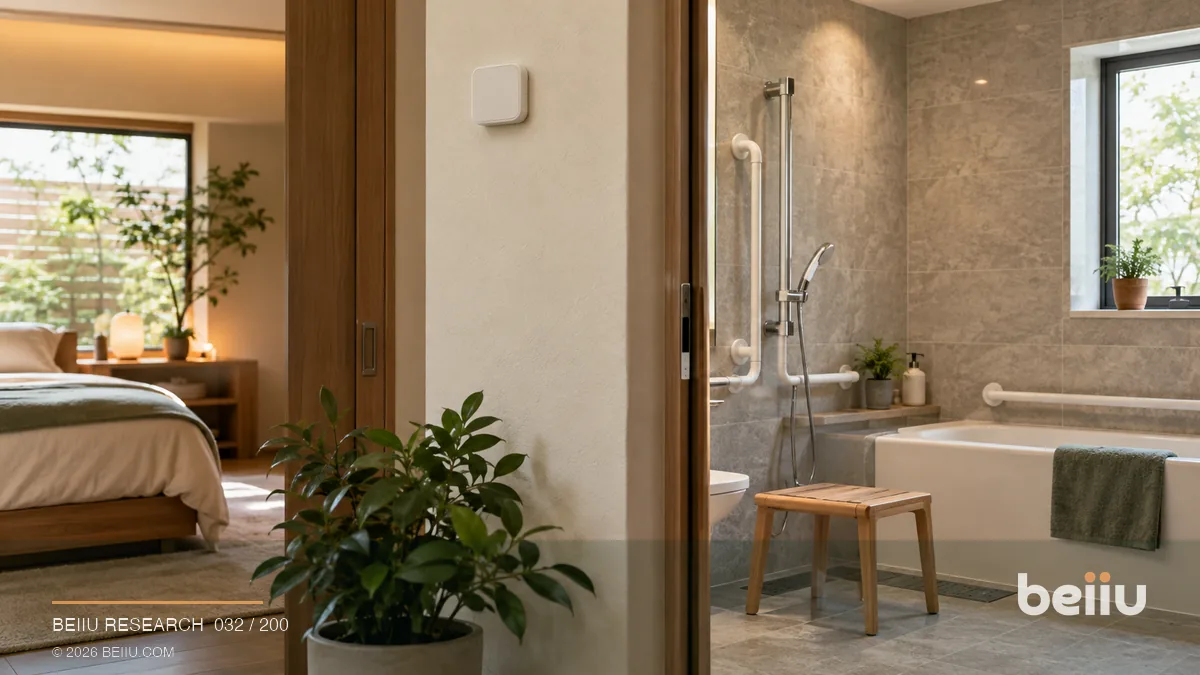
The Real Value of Millimeter Wave in Age-Friendly Housing
Non-visual sensing suits privacy-sensitive spaces but has inherent limitations
Conclusion: Installation height, obstructions, multiple occupants, and pets can all affect results, applicable conditions must be clearly disclosed
The question is how sensed events enter confirmation and response
Japanese Mimamori practices demonstrate that sensor value derives from continuous understanding of nighttime activities, bed-exit events, daily routines, and device status, rather than single alerts. Privacy and response chains must be designed simultaneously.
“Non-visual sensing suits privacy-sensitive spaces but has inherent limitations” is a proposition that evidence may support or overturn, not a conclusion established because a Japanese case exists. For how sensed events enter confirmation and response, the analysis also tests “Installation height, obstructions, multiple occupants, and pets can all affect results, applicable conditions must be clearly disclosed” while retaining population, setting, period, failed cases and the current non-technical alternative.
What each source can and cannot establish
A source can establish the policy context of “Non-visual sensing suits privacy-sensitive spaces but has inherent limitations” without establishing a user outcome, so institutional fact, case fact, editorial inference and testable hypothesis remain separate.
- 01Japan Ministry of Health, Labour and Welfare: Promotion of Care Technology ↗
Supports analysis of how Japan links care-technology adoption, workflow improvement, productivity and care quality.
- 02Japan Ministry of Health, Labour and Welfare: Priority Fields for Care Technology ↗
Confirms the official categories and definitions of priority care technologies; inclusion does not prove every product effective.
- 03Panasonic: Smart Aging Care Research ↗
Corporate R&D material that illustrates platform and scenario direction, not independent proof of product effects.
- 04Cabinet Office of Japan: Annual Report on the Ageing Society 2025 ↗
Provides the demographic, living, employment, health and participation context for Japan’s ageing society.
Move from a feature to a complete accountability chain
Millimetre wave offers non-wearable change detection without identifiable facial imagery, useful as a second layer in bedrooms and bathrooms. Value still depends on installation, multiple people, occlusion, model limits and response, not the camera-free label. The monitoring chain combines weak signals, personal baseline, time window, cross-signal interpretation, human confirmation, tiered response and closure. Door, electricity, mattress or radar data describe fragments; one absent action is not danger.
For “Non-visual sensing suits privacy-sensitive spaces but has inherent limitations”, actively seek the counterexample “equating detection with resolution”. When it occurs, preserve current service and personal choice before locating where “Installation height, obstructions, multiple occupants, and pets can all affect results, applicable conditions must be clearly disclosed” failed in requirements, product, operation or response.
Place the argument inside one observable task
Record individual rhythms of waking, leaving, electricity, sleep and toileting for two weeks, then add late waking, nights away, visitors, outage, furniture change and genuine anomalies to test thresholds and contacts. For this analysis, also record “coverage”, “false alarms” and the non-technical method so that “Installation height, obstructions, multiple occupants, and pets can all affect results, applicable conditions must be clearly disclosed” can be attributed to the intervention rather than hidden support.
Success is not a completed demonstration. “Non-visual sensing suits privacy-sensitive spaces but has inherent limitations” must remain understandable, interruptible and closable across routine, exception and unavailable states.
Transfer operating method and evidence discipline
Japanese mimamori emphasises appearing when needed and connecting to service. Transfer the combination of low-intrusion sensing, individual difference and human response, not one sensor bundle.
Redraw accountability before selecting product form
Chinese multigenerational homes, temporary care, dense housing and notification ecosystems change identity attribution and alert burden; rules require household agreement rather than defaults. Chinese household layouts, multi-generational living arrangements, and network conditions are more complex; algorithm thresholds and alert targets must be localized.
Use consistent measures across routine, exception and unavailable conditions
- 01coverage
Review the work and waiting time carried by older people, families, carers, installers and model teams around “coverage”. Improvement in “Installation height, obstructions, multiple occupants, and pets can all affect results, applicable conditions must be clearly disclosed” that depends on permanent extra labour cannot be attributed to the intervention alone.
- 02false alarms
“false alarms” must include exceptions, refusal and unavailable-system cases. While testing “Non-visual sensing suits privacy-sensitive spaces but has inherent limitations”, equating detection with resolution means an improved average still triggers pause or reframing.
- 03misses
Compare “misses” with the same task, population, version and response rule. A material version change in this analysis requires a new baseline.
- 04confirmation time
For “confirmation time”, state the population, baseline and time window in this analysis, and retain “device availability” so one attractive metric cannot conceal deterioration elsewhere.
- 05device availability
“device availability” helps answer how sensed events enter confirmation and response. For “Non-visual sensing suits privacy-sensitive spaces but has inherent limitations”, keep device output, human confirmation and completed action separate, and investigate when the three disagree.
For “Non-visual sensing suits privacy-sensitive spaces but has inherent limitations”, the period for “coverage” and “false alarms” covers weekends, nights, visitors, shift or environmental change. If “Installation height, obstructions, multiple occupants, and pets can all affect results, applicable conditions must be clearly disclosed” has health, safety or cognitive implications, it also requires predefined human review, professional referral and exclusion criteria.
Keep the conditions behind the decision traceable
Topic record: For “Non-visual sensing suits privacy-sensitive spaces but has inherent limitations”, treat “Installation height, obstructions, multiple occupants, and pets can all affect results, applicable conditions must be clearly disclosed” as a judgment that field evidence may support or overturn.
Baseline record: Testing “Non-visual sensing suits privacy-sensitive spaces but has inherent limitations” retains population, task frequency, current method, elapsed time, help, near misses and non-completion; coverage and false alarms use one denominator and period around “Installation height, obstructions, multiple occupants, and pets can all affect results, applicable conditions must be clearly disclosed”, including refusal and failed cases.
Ownership record: Around “Non-visual sensing suits privacy-sensitive spaces but has inherent limitations”, older people, families, carers, installers and model teams receive distinct duties for choice, operation, confirmation, maintenance, payment and stop authority; every action testing “Installation height, obstructions, multiple occupants, and pets can all affect results, applicable conditions must be clearly disclosed” names an owner, deadline and fallback.
Exception-closure record: “Non-visual sensing suits privacy-sensitive spaces but has inherent limitations” predefines “equating detection with resolution” as a failed case and retains preceding conditions, version, human takeover, recovery time and impact; closure requires recovery of the life task behind “Installation height, obstructions, multiple occupants, and pets can all affect results, applicable conditions must be clearly disclosed” and human confirmation.
Change and exit record: After a change in threshold, place, people, shift, connectivity or service resources affecting “Non-visual sensing suits privacy-sensitive spaces but has inherent limitations”, retain the reason, approver, new baseline and grounds under “Installation height, obstructions, multiple occupants, and pets can all affect results, applicable conditions must be clearly disclosed” for continuation, downgrade or exit.
Decision rationale: Continue, modify or stop decisions around “Non-visual sensing suits privacy-sensitive spaces but has inherent limitations” cite source records, show how misses and confirmation time support “Installation height, obstructions, multiple occupants, and pets can all affect results, applicable conditions must be clearly disclosed”, and retain unresolved uncertainty.
Review cadence: At pilot entry, first exception, version change and before scale, reassess “Installation height, obstructions, multiple occupants, and pets can all affect results, applicable conditions must be clearly disclosed” and compare coverage, false alarms, misses, confirmation time, device availability under unchanged definitions.
Know when not to adopt and when to stop
Reduce or exit when one signal becomes a conclusion, multi-person events are misattributed, outage is invisible, alerts lack confirmation, or the person rejects inference about routine. Retain a lower-technology, lower-burden and reversible alternative.
Five checks before procurement, pilots or partnerships
Population and task
For “Non-visual sensing suits privacy-sensitive spaces but has inherent limitations”, define who completes which task in what setting and retain the current non-technical alternative so the proposition becomes testable.
Ownership and time
Around “Installation height, obstructions, multiple occupants, and pets can all affect results, applicable conditions must be clearly disclosed”, name receipt, confirmation, action, maintenance and stop ownership across older people, families, carers, installers and model teams, including escalation and takeover deadlines.
Evidence threshold
To test “Non-visual sensing suits privacy-sensitive spaces but has inherent limitations”, track coverage, false alarms, misses, confirmation time, device availability together, retaining denominator, period, version change, refusal and incomplete cases.
Counterexample and failure
Actively test when equating detection with resolution occurs and whether it overturns the operating conditions behind “Installation height, obstructions, multiple occupants, and pets can all affect results, applicable conditions must be clearly disclosed”.
Exit and review
When preference, ability, housing, household or service access changes, allow “Non-visual sensing suits privacy-sensitive spaces but has inherent limitations” to reduce automation, change rules or exit, then reassess how sensed events enter confirmation and response.
Turn overseas experience into local methods
For BEIIU / 辈佑, “Installation height, obstructions, multiple occupants, and pets can all affect results, applicable conditions must be clearly disclosed” becomes useful when it leads to clearer requirements, evaluation methods, accountability and exit conditions in product and partnership practice.
References
Institutional facts, corporate material, case descriptions and BEIIU interpretation remain separate. Original-publisher links allow readers to check year, population and scope.