
Managing Sensor False Alarms and Manual Review Mechanisms Under Multi-Scenario Interference
The article deeply analyzes false positive and false negative issues of smart aging care products in complex scenarios involving multiple residents, pet activity, environmental occlusion, and network interruptions, proposing manual review solutions
Conclusion: Although the Ministry of Industry and Information Technology's catalog has included family service robots and other smart products, why does catalog entry not equate to effective scenario validation, and how can sensor false alarms in complex environments be managed
Separate national facts, local variation and analytical inference
Intelligence has value only when it improves the task and its accountability chain. This study examines “data and accountability boundaries in home sensing” as a reviewable research object: The unit of analysis is one complete sensing, inference, notification, human-confirmation and service-response event, not a model specification, demo or catalogue status. In claims about “data and accountability boundaries in home sensing”, increased or declined requires a dated comparison and denominator, while mechanism, opportunity and brand judgment remain analytical rather than statistical.
The research question above requires this minimum evidence base: The minimum baseline covers dwelling and installation conditions, routine and exception samples, false positives and negatives, outages, human takeover, data fields, retention and deletion. If “data and accountability boundaries in home sensing” lacks an element, the study may state a direction or hypothesis, not a local service volume, procurement quantity or revenue estimate.
Read the fact cards, then verify definitions in the primary material
The catalog released by the Ministry of Industry and Information Technology covers broad categories including health management, assistive devices, and family service robots, but selection itself does not equate to validation of effectiveness in all scenarios.
Definition source:Ministry of Industry and Information Technology: Response on the Supply of Smart Healthy-Ageing Products
Open primary material ↗The 2024 version of the promotion catalog explicitly includes family service robots and age-friendly smart products, aiming to promote scaled and standardized development.
Definition source:Ministry of Industry and Information Technology et al.: 2024 Catalogue of Smart Healthy-Ageing Products and Services
Open primary material ↗Document No. 1 of the General Office of the State Council [2024] proposes that the silver economy needs to develop towards scaling, standardization, clustering, and branding, emphasizing quality control.
Definition source:General Office of the State Council: Guiding Opinion on Developing the Silver Economy and Improving Older People's Well-being
Open primary material ↗Primary sources and use boundaries
Ministry of Industry and Information Technology: Response on the Supply of Smart Healthy-Ageing Products
MIIT’s public response describes work on the supply and promotion of smart healthy-ageing products and services. Catalogue counts reflect supply-building activity, not proof that every listed solution has completed real-world validation.
Check source 01 ↗Ministry of Industry and Information Technology et al.: 2024 Catalogue of Smart Healthy-Ageing Products and Services
The 2024 smart healthy-ageing catalogue covers health management, assistive products, care monitoring, home-service robots and age-friendly smart products. Catalogue inclusion is not certification of contextual effectiveness.
Check source 02 ↗General Office of the State Council: Guiding Opinion on Developing the Silver Economy and Improving Older People's Well-being
The 2024 State Council opinion defines the silver economy as activities that provide products or services to older people and prepare for later life, and calls for scale, standards, clusters and brands.
Check source 03 ↗General Offices of the CPC Central Committee and State Council: Opinion on Building a Basic Elderly-Care Service System
The basic eldercare service framework emphasises service lists, comprehensive ability assessment, precise identification of people in difficulty, and a shift from people finding services to services finding people.
Check source 04 ↗The fact cards below retain year, geography and source; the source cards return to definitions in the original material. Forecast, research estimate, catalogue listing, policy objective and observed outcome keep different evidence status even when they concern “data and accountability boundaries in home sensing”.
Move from correlation to a plausible operating mechanism
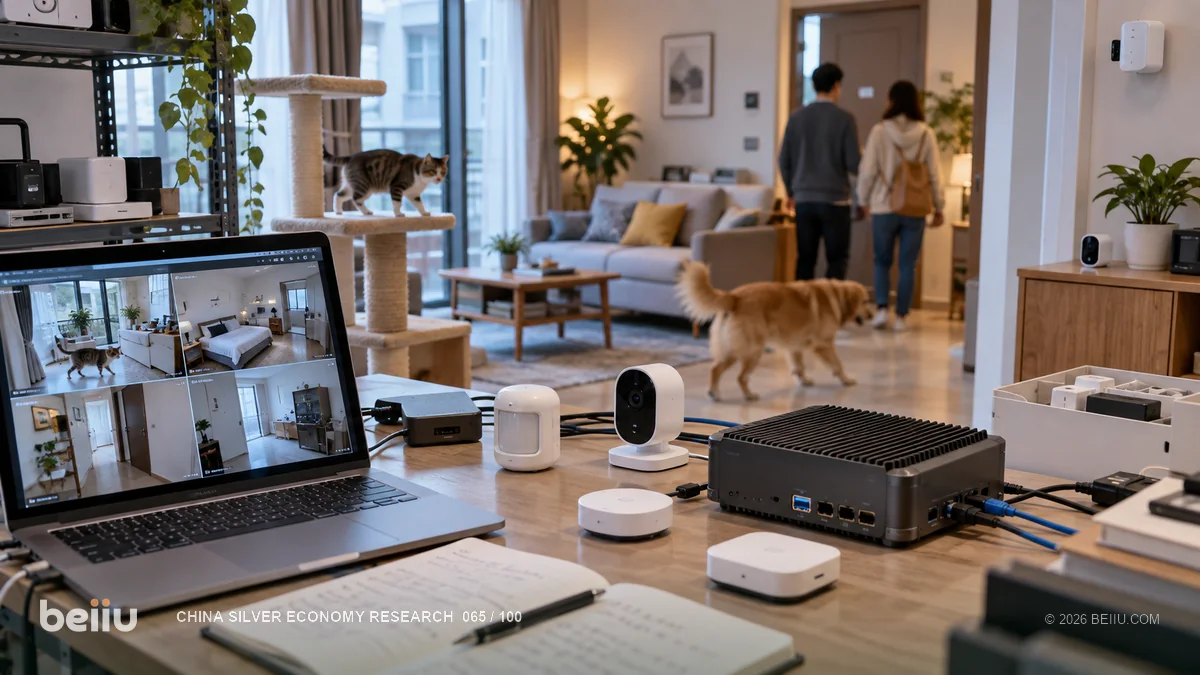
The Ministry of Industry and Information Technology's promotion catalog covers health management, assistive devices, and family service robots, aiming to promote scaled development, but selection does not mean effectiveness in all scenarios. Document No. 1 of the General Office of the State Council [2024] emphasizes that the silver economy needs to develop towards quality control. The reality challenge lies in the fact that activities of multiple residents, pet movement, furniture occlusion, or network interruptions easily lead to sensor false alarms or false negatives. Without effective management, the system will frequently issue invalid alerts, reducing user trust. Therefore, algorithm optimization mechanisms targeting specific interference sources must be established, and necessary manual review links introduced as the final defense line when technology fails, ensuring the accuracy and reliability of service instructions.
Millimetre-wave sensing avoids images but can still create personal data about presence, activity, sleep or behaviour; privacy depends on fields, purpose, retention, access and withdrawal. In addition, Sensing, models, devices, human confirmation and service response form one operating system. “Establish testing standards for millimeter-wave radar home deployment under complex lighting and electromagnetic environments” still requires temporal order, alternatives, local conditions and accountable implementation rather than a jump from macro correlation to sales or service effect.
Do not equate a catalogue, specification or demonstration with contextual effectiveness. A concrete counterexample is: If an algorithm update changes use or error structure without renewed notice and calibration, a non-camera system does not automatically retain long-term consent. Until that counterexample to “data and accountability boundaries in home sensing” is addressed, the conclusion retains conditions and a bounded scope.
Families, public services and industry change differently
Product developers need to conduct specialized algorithm training for interference sources such as pets and occlusion, rather than merely pursuing single-scenario accuracy. Operators should design a hybrid 'technology plus human' response process, automatically triggering human confirmation when system confidence is insufficient. Meanwhile, mechanisms for local caching and resume transmission during network interruptions must be established. Regulators and standard setters should promote the establishment of access standards including complex interference testing, avoiding catalog entry becoming a formality, ensuring smart products truly function in real home environments rather than adding burdens to families.
For “data and accountability boundaries in home sensing”, households care about time, cost, dignity and continued choice, public bodies must test identification, equity, fiscal durability and incident accountability, and operators must state the workforce, maintenance and compliance required by “Establish testing standards for millimeter-wave radar home deployment under complex lighting and electromagnetic environments” and who pays for exceptions.
Model teams own algorithm limits, installers own field conditions, operators own alert closure, and older people and families retain consent, pause and manual alternatives. Service radius, cost and access for “data and accountability boundaries in home sensing” therefore require separate calculations for dense cities, out-migration counties and dispersed rural communities.
Translate the macro judgment into one observable project
Before installation map blind zones and interference; afterwards separate routine activity, visitors, pets, stillness, outages and genuine exceptions, retaining human-review outcomes. Start with one place, one population and one task, preserving time, cost, failure and family backfill under the current alternative before introducing “Establish testing standards for millimeter-wave radar home deployment under complex lighting and electromagnetic environments”.
The observation period for “data and accountability boundaries in home sensing” includes routine work, holidays, workforce change, unavailable devices or networks, refusal and exit, and requires the project to show whether the population is identified correctly, incidents close, and people, data and essential service recover when the intervention stops.
An opportunity becomes a project only through constraints
- 01Establish testing standards for millimeter-wave radar home deployment under complex lighting and electromagnetic environments
Validation of “Establish testing standards for millimeter-wave radar home deployment under complex lighting and electromagnetic environments” names the user, payer, operator and maintainer separately. If “data and accountability boundaries in home sensing” relies on permanent extra responsibility from pilot staff, the observed effect is unlikely to survive scale.
- 02Develop localized robot control algorithms with edge computing capabilities to reduce reliance on the cloud and improve response speed
Test this direction against the counterexample “The mechanical structure of family service robots poses collision risks in narrow passages, liability definition must be clear”. “data and accountability boundaries in home sensing” should move forward only if “model error” still improves after compliance, workforce, maintenance and exit costs are included.
- 03Build a gap assessment model between catalog products and real home scenarios to guide users in making rational purchasing decisions
For “data and accountability boundaries in home sensing”, “Build a gap assessment model between catalog products and real home scenarios to guide users in making rational purchasing decisions” starts with one place, one task and one defined population, records routine, exception, refusal and incomplete cases, and retains a workable path without the intervention.
Treat “Establish testing standards for millimeter-wave radar home deployment under complex lighting and electromagnetic environments” as a proposition. Move forward only when device availability improves against baseline and maintenance, workforce, compliance, payment and exit costs are not transferred to older people or frontline staff.
Put conditions that could overturn the conclusion in the main text
- 01Catalog entry only represents that the product meets basic access conditions, not that it is effective in specific floor plans or interference environments
This condition changes the scope of “Establish testing standards for millimeter-wave radar home deployment under complex lighting and electromagnetic environments”. Stage review of “data and accountability boundaries in home sensing” retains non-completion, exit, complaint and excluded-population cases rather than counting only successful entrants.
- 02The mechanical structure of family service robots poses collision risks in narrow passages, liability definition must be clear
For “The mechanical structure of family service robots poses collision risks in narrow passages, liability definition must be clear”, compare rules, resources and cost across city, county and rural settings. National material indicates direction; the local decision on “data and accountability boundaries in home sensing” still needs field data, accountable owners and an executable alternative.
- 03Over-reliance on a single smart device may cause elderly people to develop 'technology dependence', once a failure occurs, it will trigger a care vacuum
Once “Over-reliance on a single smart device may cause elderly people to develop 'technology dependence', once a failure occurs, it will trigger a care vacuum” holds, pause the affected stage and establish facts before narrowing, modifying or exiting. Risk in “data and accountability boundaries in home sensing” cannot be assigned to user capability or absorbed indefinitely by families and frontline staff.
Put “Catalog entry only represents that the product meets basic access conditions, not that it is effective in specific floor plans or interference environments” into entry and stop criteria. If local data, interviews, complaints or incomplete cases support this counterexample to “data and accountability boundaries in home sensing”, narrow, modify or stop rather than discard adverse evidence.
Measure average improvement and who is left out
- 01 · device availability
For “data and accountability boundaries in home sensing”, report baseline, pilot and post-exit states for “device availability”, including policy, workforce or system-version changes so external effort is not attributed to the intervention.
- 02 · model error
“data and accountability boundaries in home sensing” reads “model error” at aggregate and high-risk levels, and coverage does not prove equity when low-income, oldest-old, disabled or remote groups are omitted.
- 03 · human takeover
“data and accountability boundaries in home sensing” assigns interpretive responsibility for “human takeover”: who produces and reviews data, what triggers action and which record governs disagreement.
- 04 · response time
For “data and accountability boundaries in home sensing”, “response time” retains population, geography, denominator, period and incomplete cases to test “Establish testing standards for millimeter-wave radar home deployment under complex lighting and electromagnetic environments”, because an average improvement alone is insufficient.
- 05 · data minimisation
For “data and accountability boundaries in home sensing”, report baseline, pilot and post-exit states for “data minimisation”, including policy, workforce or system-version changes so external effort is not attributed to the intervention.
device availability, model error, human takeover, response time and data minimisation answer different questions about scale, process, outcome, equity or cost. Each metric for “data and accountability boundaries in home sensing” needs a population, denominator, period, version and missing-case record.
Build a durable point of view from evidence
Catalog entry is just the starting point; scenario validation is the key. Interference from multiple residents and pets is the norm; relying solely on algorithms cannot eradicate false alarms. A hybrid mechanism of 'technical screening plus manual review' must be established, and fault-tolerant solutions designed for extreme situations such as occlusion and network outages. Only by acknowledging technical limitations in complex environments and relying on human intervention as a safety net can the reliability and safety of smart aging care be truly achieved.
BEIIU / 辈佑 considers public evidence, scenario constraints and real-world counterexamples together to identify which opportunities can move into product and partnership practice and which conditions require further observation. New primary evidence and field experience will continue to refine that perspective.
Turn macro research into five practical questions
Fact boundary
For “data and accountability boundaries in home sensing”, what can national evidence establish, what can it not establish, and which local data are required to answer the opening research question?
Current alternative
Before a new product or service addresses “data and accountability boundaries in home sensing”, how do families, communities or institutions complete the task, and what are its time, cost, failure and user-burden baselines?
Minimum test
Choose one bounded setting from “Establish testing standards for millimeter-wave radar home deployment under complex lighting and electromagnetic environments”, change one material condition, and test “device availability” together with at least one counter-metric.
Counterexample
For “data and accountability boundaries in home sensing”, actively look for “Catalog entry only represents that the product meets basic access conditions, not that it is effective in specific floor plans or interference environments”; if it limits “Establish testing standards for millimeter-wave radar home deployment under complex lighting and electromagnetic environments” locally, narrow the conclusion and decide whether to pause or use another path.
Public accountability
For “data and accountability boundaries in home sensing”, name who authorises entry, operates, handles exceptions, maintains data and equipment, and may stop the service; a missing role leaves the proposal as a hypothesis.
The continue, change or stop floor is: Stop operation when the system cannot explain an alert, no one handles low-confidence events, collection continues after withdrawal, or failure has no alternative path. For “data and accountability boundaries in home sensing”, repeat this check at entry, mid-pilot and scale review, updating the conclusion, budget, ownership and exit arrangement.
References
For “data and accountability boundaries in home sensing”, this study prioritises original government, public-institution and international sources, retains reference years, and clearly labels forecasts or estimates.
- Ministry of Industry and Information Technology: Response on the Supply of Smart Healthy-Ageing Products ↗
- Ministry of Industry and Information Technology et al.: 2024 Catalogue of Smart Healthy-Ageing Products and Services ↗
- General Office of the State Council: Guiding Opinion on Developing the Silver Economy and Improving Older People's Well-being ↗
- General Offices of the CPC Central Committee and State Council: Opinion on Building a Basic Elderly-Care Service System ↗