
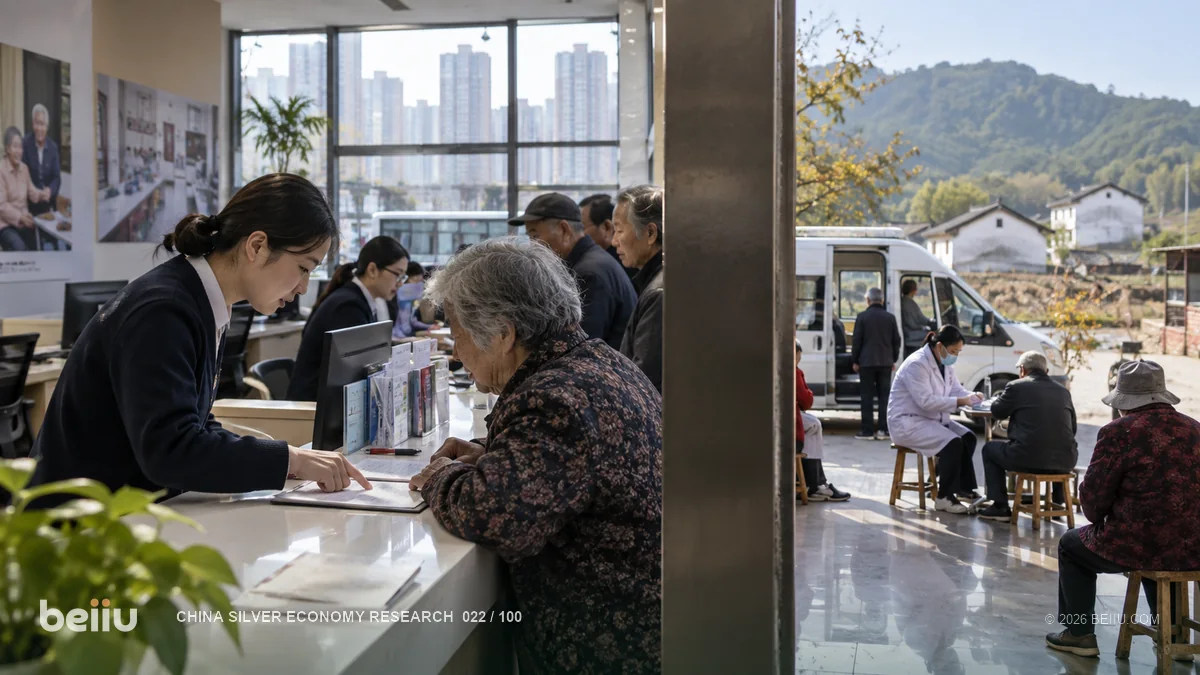
Service Networks Under Urban-Rural Dualism: From Planning Blueprints to Execution Gaps
Combining the '14th Five-Year National Plan for the Development of Elderly Care and the Construction of an Elderly Care Service System' with the 'Opinions on Deepening the Reform and Development of Elderly Care Services', this study examines the structural disparities in urban-rural elderly care service networks regarding infrastructure, talent allocation, and the integration of medical and elderly care services
Conclusion: Within the framework of 'home-based care, community-supported, and institutional professional support', how can urban and rural resources flow effectively to fill supply gaps in rural areas
Separate national facts, local variation and analytical inference
Policy direction must be translated into populations, service lists, payment and accountability. This study examines “county access, referral and workforce supply” as a reviewable research object: The unit of analysis is the full path by which an eligible person receives one defined service, not the number of verbs in a policy document. In claims about “county access, referral and workforce supply”, increased or declined requires a dated comparison and denominator, while mechanism, opportunity and brand judgment remain analytical rather than statistical.
The research question above requires this minimum evidence base: The minimum baseline covers eligibility, ability assessment, service catalogue, application and outreach, payment, waiting time, appeal and quality review. If “county access, referral and workforce supply” lacks an element, the study may state a direction or hypothesis, not a local service volume, procurement quantity or revenue estimate.
Read the fact cards, then verify definitions in the primary material
The basic elderly care service network is expected to be essentially established by 2029, with the system maturing and taking shape by 2035, emphasizing long-term goals of coordinated urban-rural development.
Definition source:CPC Central Committee and State Council: Opinion on Deepening Reform and Development of Elderly-Care Services
Open primary material ↗The plan emphasizes coordination among home-based, community-based, and institutional care, combined with medical and elderly care services, to promote the coordinated development of elderly care undertakings and industries.
Definition source:State Council: 14th Five-Year Plan for National Ageing Programmes and Elderly-Care Services
Open primary material ↗The development of the silver economy requires promoting large-scale, standardized, clustered, and branded growth, which poses challenges to dispersed rural services.
Definition source:General Office of the State Council: Guiding Opinion on Developing the Silver Economy and Improving Older People's Well-being
Open primary material ↗Primary sources and use boundaries
CPC Central Committee and State Council: Opinion on Deepening Reform and Development of Elderly-Care Services
The eldercare reform opinion calls for a tiered, classified, broadly accessible, urban-rural and sustainable service system, with staged objectives for 2029 and 2035.
Check source 01 ↗State Council: 14th Five-Year Plan for National Ageing Programmes and Elderly-Care Services
The 14th Five-Year Plan calls for coordination among home, community and institutional care, integration of medical and wellness services, and coordination between ageing services and industry. It sets system direction, not proof of a project outcome.
Check source 02 ↗General Office of the State Council: Guiding Opinion on Developing the Silver Economy and Improving Older People's Well-being
The 2024 State Council opinion defines the silver economy as activities that provide products or services to older people and prepare for later life, and calls for scale, standards, clusters and brands.
Check source 03 ↗General Offices of the CPC Central Committee and State Council: Opinion on Building a Basic Elderly-Care Service System
The basic eldercare service framework emphasises service lists, comprehensive ability assessment, precise identification of people in difficulty, and a shift from people finding services to services finding people.
Check source 04 ↗The fact cards below retain year, geography and source; the source cards return to definitions in the original material. Forecast, research estimate, catalogue listing, policy objective and observed outcome keep different evidence status even when they concern “county access, referral and workforce supply”.
Move from correlation to a plausible operating mechanism
The urban-rural dual structure results in a marked gradient disparity in elderly care service networks. Urban areas rely on institutions to support communities, whereas rural areas face the dilemma of absent institutions and hollowed-out communities. Although planning documents propose urban-rural coordination, rural areas often struggle to meet standardized 'large-scale' requirements during implementation. Integrating medical and elderly care services is particularly difficult in rural regions due to insufficient downward flow of medical resources. To achieve full network coverage, simply replicating the urban model is insufficient; instead, suitable mutual-aid and embedded service pathways must be explored for rural areas, while leveraging digital means to overcome geographical limitations and allow urban professional forces to remotely support rural nodes.
County eldercare does not copy urban facility density; it links dispersed rural need, county-level expertise and cross-township transport into an accessible network. In addition, Several transmission layers sit between a central objective, local implementation and a service a household can actually obtain. “Utilize digital technology to build remote medical and nursing guidance platforms linking urban and rural areas to reduce service costs in rural regions” still requires temporal order, alternatives, local conditions and accountable implementation rather than a jump from macro correlation to sales or service effect.
Do not present policy encouragement as project support, funding or procurement already received. A concrete counterexample is: If a project relies on temporary dispatched staff, stops during holidays or covers only county-town residents, average coverage does not establish rural access. Until that counterexample to “county access, referral and workforce supply” is addressed, the conclusion retains conditions and a bounded scope.
Families, public services and industry change differently
Rural families face a more severe care vacuum, necessitating increased fiscal transfers from the government to support rural facility construction. Industry opportunities lie in developing low-cost, easy-to-operate age-friendly products and telemedicine solutions for rural areas. Ignoring urban-rural disparities could cause policy goals to fail in rural regions, exacerbating social inequity.
For “county access, referral and workforce supply”, households care about time, cost, dignity and continued choice, public bodies must test identification, equity, fiscal durability and incident accountability, and operators must state the workforce, maintenance and compliance required by “Utilize digital technology to build remote medical and nursing guidance platforms linking urban and rural areas to reduce service costs in rural regions” and who pays for exceptions.
Policy makers define entitlement, local authorities allocate resources, providers deliver, and an independent or regulatory function reviews outcomes. Service radius, cost and access for “county access, referral and workforce supply” therefore require separate calculations for dense cities, out-migration counties and dispersed rural communities.
Translate the macro judgment into one observable project
Test 30-, 60- and 90-minute catchments for population, roads, seasons, shifts, worker retention, referral and family travel, defining tasks that village points can truly deliver. Start with one place, one population and one task, preserving time, cost, failure and family backfill under the current alternative before introducing “Utilize digital technology to build remote medical and nursing guidance platforms linking urban and rural areas to reduce service costs in rural regions”.
The observation period for “county access, referral and workforce supply” includes routine work, holidays, workforce change, unavailable devices or networks, refusal and exit, and requires the project to show whether the population is identified correctly, incidents close, and people, data and essential service recover when the intervention stops.
An opportunity becomes a project only through constraints
- 01Utilize digital technology to build remote medical and nursing guidance platforms linking urban and rural areas to reduce service costs in rural regions
Test this direction against the counterexample “Weak rural infrastructure may constrain the implementation of digital services due to limitations in network coverage and power stability”. “county access, referral and workforce supply” should move forward only if “eligible population” still improves after compliance, workforce, maintenance and exit costs are included.
- 02Cultivate localized mutual-aid elderly care organizations in rural areas, combining land policies to develop courtyard economy-based elderly care models
For “county access, referral and workforce supply”, “Cultivate localized mutual-aid elderly care organizations in rural areas, combining land policies to develop courtyard economy-based elderly care models” starts with one place, one task and one defined population, records routine, exception, refusal and incomplete cases, and retains a workable path without the intervention.
- 03Facilitate partnerships between urban elderly care institutions and rural communities to establish a delivery mechanism of 'urban professionalism plus rural stations'
Before turning “Facilitate partnerships between urban elderly care institutions and rural communities to establish a delivery mechanism of 'urban professionalism plus rural stations'” into a project, define place, population and the current alternative, then establish a comparable baseline for “implementing owner”. For “county access, referral and workforce supply”, need does not prove that households, institutions or public budgets can pay sustainably.
Treat “Utilize digital technology to build remote medical and nursing guidance platforms linking urban and rural areas to reduce service costs in rural regions” as a proposition. Move forward only when eligible population improves against baseline and maintenance, workforce, compliance, payment and exit costs are not transferred to older people or frontline staff.
Put conditions that could overturn the conclusion in the main text
- 01Weak rural infrastructure may constrain the implementation of digital services due to limitations in network coverage and power stability
For “Weak rural infrastructure may constrain the implementation of digital services due to limitations in network coverage and power stability”, compare rules, resources and cost across city, county and rural settings. National material indicates direction; the local decision on “county access, referral and workforce supply” still needs field data, accountable owners and an executable alternative.
- 02Low digital literacy among left-behind elderly in rural areas means over-reliance on online services could exacerbate the digital divide
Once “Low digital literacy among left-behind elderly in rural areas means over-reliance on online services could exacerbate the digital divide” holds, pause the affected stage and establish facts before narrowing, modifying or exiting. Risk in “county access, referral and workforce supply” cannot be assigned to user capability or absorbed indefinitely by families and frontline staff.
- 03Relying solely on market mechanisms is difficult to cover low-profit rural areas, the government must clearly define its safety net boundaries
Turn “Relying solely on market mechanisms is difficult to cover low-profit rural areas, the government must clearly define its safety net boundaries” into an entry and stop condition for “county access, referral and workforce supply”, naming who checks it, which record governs and when review occurs. If “Facilitate partnerships between urban elderly care institutions and rural communities to establish a delivery mechanism of 'urban professionalism plus rural stations'” remains constrained, future optimisation is not a substitute for pause.
Put “Weak rural infrastructure may constrain the implementation of digital services due to limitations in network coverage and power stability” into entry and stop criteria. If local data, interviews, complaints or incomplete cases support this counterexample to “county access, referral and workforce supply”, narrow, modify or stop rather than discard adverse evidence.
Measure average improvement and who is left out
- 01 · eligible population
“county access, referral and workforce supply” reads “eligible population” at aggregate and high-risk levels, and coverage does not prove equity when low-income, oldest-old, disabled or remote groups are omitted.
- 02 · public and private payment
“county access, referral and workforce supply” assigns interpretive responsibility for “public and private payment”: who produces and reviews data, what triggers action and which record governs disagreement.
- 03 · implementing owner
For “county access, referral and workforce supply”, “implementing owner” retains population, geography, denominator, period and incomplete cases to test “Facilitate partnerships between urban elderly care institutions and rural communities to establish a delivery mechanism of 'urban professionalism plus rural stations'”, because an average improvement alone is insufficient.
- 04 · service list
For “county access, referral and workforce supply”, report baseline, pilot and post-exit states for “service list”, including policy, workforce or system-version changes so external effort is not attributed to the intervention.
- 05 · outcome oversight
“county access, referral and workforce supply” reads “outcome oversight” at aggregate and high-risk levels, and coverage does not prove equity when low-income, oldest-old, disabled or remote groups are omitted.
eligible population, public and private payment, implementing owner, service list and outcome oversight answer different questions about scale, process, outcome, equity or cost. Each metric for “county access, referral and workforce supply” needs a population, denominator, period, version and missing-case record.
Build a durable point of view from evidence
BEIIU observes that the gap in urban-rural elderly care service networks is not merely a matter of facilities but also a disparity in operational capabilities. The future breakthrough lies in 'lightweight' operations, empowering existing rural personnel through standardized remote support rather than blindly constructing heavy-asset institutions.
BEIIU / 辈佑 considers public evidence, scenario constraints and real-world counterexamples together to identify which opportunities can move into product and partnership practice and which conditions require further observation. New primary evidence and field experience will continue to refine that perspective.
Turn macro research into five practical questions
Fact boundary
For “county access, referral and workforce supply”, what can national evidence establish, what can it not establish, and which local data are required to answer the opening research question?
Current alternative
Before a new product or service addresses “county access, referral and workforce supply”, how do families, communities or institutions complete the task, and what are its time, cost, failure and user-burden baselines?
Minimum test
Choose one bounded setting from “Utilize digital technology to build remote medical and nursing guidance platforms linking urban and rural areas to reduce service costs in rural regions”, change one material condition, and test “eligible population” together with at least one counter-metric.
Counterexample
For “county access, referral and workforce supply”, actively look for “Weak rural infrastructure may constrain the implementation of digital services due to limitations in network coverage and power stability”; if it limits “Utilize digital technology to build remote medical and nursing guidance platforms linking urban and rural areas to reduce service costs in rural regions” locally, narrow the conclusion and decide whether to pause or use another path.
Public accountability
For “county access, referral and workforce supply”, name who authorises entry, operates, handles exceptions, maintains data and equipment, and may stop the service; a missing role leaves the proposal as a hypothesis.
The continue, change or stop floor is: A policy objective is not an implemented result when the population cannot be identified, funding is not durable, ownership is missing or complaints cannot close. For “county access, referral and workforce supply”, repeat this check at entry, mid-pilot and scale review, updating the conclusion, budget, ownership and exit arrangement.
References
For “county access, referral and workforce supply”, this study prioritises original government, public-institution and international sources, retains reference years, and clearly labels forecasts or estimates.
- CPC Central Committee and State Council: Opinion on Deepening Reform and Development of Elderly-Care Services ↗
- State Council: 14th Five-Year Plan for National Ageing Programmes and Elderly-Care Services ↗
- General Office of the State Council: Guiding Opinion on Developing the Silver Economy and Improving Older People's Well-being ↗
- General Offices of the CPC Central Committee and State Council: Opinion on Building a Basic Elderly-Care Service System ↗