
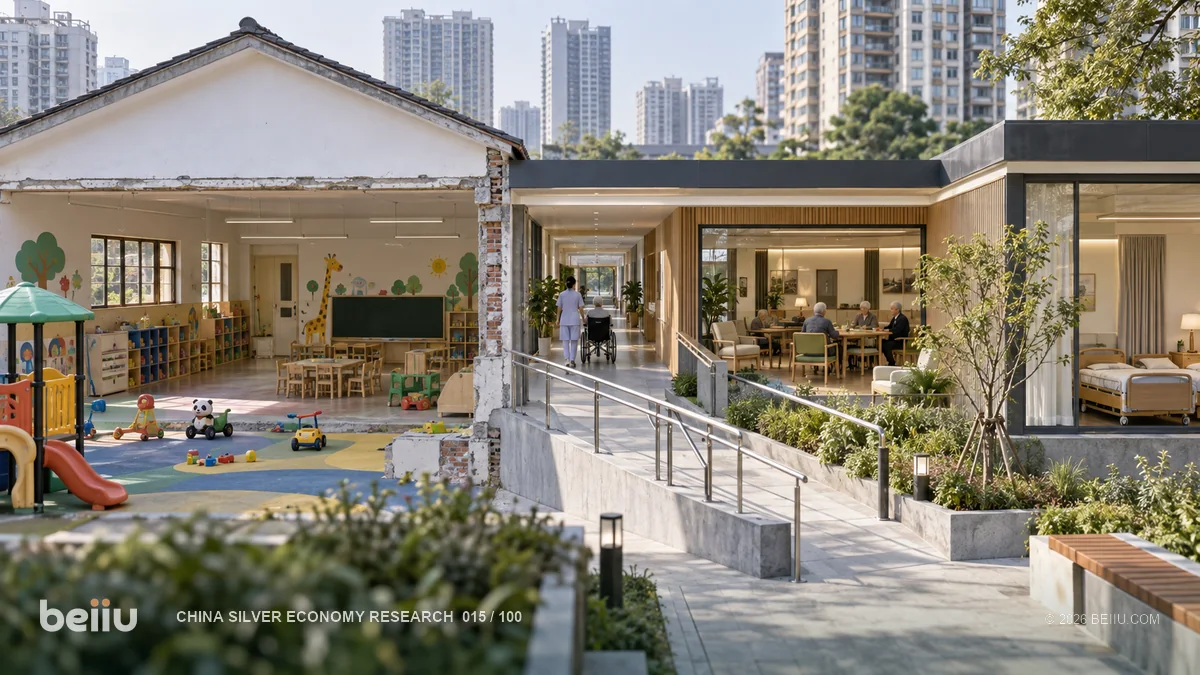
Spatial Substitution Under Kindergarten Contraction: Compliance Boundaries and Operational Validation for Transforming Existing Kindergartens into Elderly Care
Based on data from 2023–2024 showing a sharp decline in the number of kindergartens, this study explores the feasibility of converting idle early childhood education facilities into community elderly care nodes. The article strictly defines hard constraints regarding property rights changes, planning adjustments, fire safety inspections, and accessibility retrofitting, emphasizing that such transformations do not occur automatically but require conditional reconstruction following rigorous medical integration and demand assessments
Conclusion: Amidst a sustained decline in birth rates leading to the closure of numerous kindergartens, can idle early childhood education spaces be legally, safely, and sustainably converted into community elderly care facilities
Separate national facts, local variation and analytical inference
Fewer children and more older people do not automatically convert one type of space into another. This study examines “compliance and operation of kindergarten conversion” as a reviewable research object: The unit of analysis is one property and its service catchment, not the national number of closed kindergartens, shops or factories. In claims about “compliance and operation of kindergarten conversion”, increased or declined requires a dated comparison and denominator, while mechanism, opportunity and brand judgment remain analytical rather than statistical.
The research question above requires this minimum evidence base: The minimum baseline covers title, land and planning use, structure and fire safety, accessibility, transport, health links, local need, conversion capex and recurring opex. If “compliance and operation of kindergarten conversion” lacks an element, the study may state a direction or hypothesis, not a local service volume, procurement quantity or revenue estimate.
Read the fact cards, then verify definitions in the primary material
In 2023, the number of kindergartens nationwide decreased by 14,808 compared to the previous year, with a reduction of 5.3457 million enrolled children.
Definition source:Ministry of Education: 2023 Statistical Bulletin on National Education Development
Open primary material ↗The total number of kindergartens further declined to 253,300 in 2024, but policy explicitly states that the decline in total data does not equate to every closed kindergarten being directly convertible into elderly care facilities.
Definition source:Ministry of Education: 2024 Statistical Bulletin on National Education Development
Open primary material ↗National planning aims to establish a basic elderly care service network by 2029, requiring home-based care supported by communities, providing a policy window for the transformation of existing spaces.
Definition source:CPC Central Committee and State Council: Opinion on Deepening Reform and Development of Elderly-Care Services
Open primary material ↗Primary sources and use boundaries
Ministry of Education: 2023 Statistical Bulletin on National Education Development
The Ministry of Education’s 2023 bulletin records changes in preschool institutions and enrolment. National totals provide context for resource adjustment but do not prove that a particular site is idle or suitable for eldercare conversion.
Check source 01 ↗Ministry of Education: 2024 Statistical Bulletin on National Education Development
The Ministry of Education reports 253,300 kindergartens in 2024, including 221,000 inclusive kindergartens, or 87.26%.
Check source 02 ↗CPC Central Committee and State Council: Opinion on Deepening Reform and Development of Elderly-Care Services
The eldercare reform opinion calls for a tiered, classified, broadly accessible, urban-rural and sustainable service system, with staged objectives for 2029 and 2035.
Check source 03 ↗Ministry of Education: 2025 Statistical Bulletin on National Education Development
The Ministry of Education reports 231,900 kindergartens in 2025, including 203,100 inclusive kindergartens, or 87.57%. The national count does not prove that a particular property is vacant or convertible to eldercare.
Check source 04 ↗The fact cards below retain year, geography and source; the source cards return to definitions in the original material. Forecast, research estimate, catalogue listing, policy objective and observed outcome keep different evidence status even when they concern “compliance and operation of kindergarten conversion”.
Move from correlation to a plausible operating mechanism
The physical contraction of kindergartens (a reduction of nearly 15,000 in 2023) has indeed released physical space, but the substitution of space functions is far from a simple physical fill. The core obstacles lie in the statutory change of planned land use and differences in fire safety inspection standards. Early childhood education buildings are typically designed for high-density foot traffic and low floors, whereas elderly care facilities must meet higher fire compartment requirements, accessibility standards (such as elevator configuration and handrail systems), and medical emergency integration capabilities. Furthermore, property rights are complex, with some private kindergartens facing legal risks in asset disposal. Therefore, such transformations must be viewed as a 'conditional' strategy for activating existing stock rather than a universal trend. Any retrofitting plan must first pass functional change approval from planning departments, complete specialized fire safety and accessibility assessments for the elderly population, and verify the rigid elderly care demand in surrounding communities to avoid creating new resource mismatches.
A fall in kindergarten numbers establishes an aggregate education trend; it does not prove that one building is vacant or replace title, use, fire, structural and operating review. In addition, Planning use, fire safety, transport, health links and operating capacity determine whether existing space can be reused. “Leverage the existing community trust foundation of kindergartens to rapidly establish 'elderly care + child care' mutual-aid community service centers” still requires temporal order, alternatives, local conditions and accountable implementation rather than a jump from macro correlation to sales or service effect.
Do not turn a national fall in kindergarten numbers into proof that a particular property is convertible. A concrete counterexample is: When the property still carries education duties, title is disputed or required care conditions cannot be obtained, the sound conclusion may be not to convert. Until that counterexample to “compliance and operation of kindergarten conversion” is addressed, the conclusion retains conditions and a bounded scope.
Families, public services and industry change differently
For families, if such transformations succeed, they will greatly alleviate spatial conflicts over 'one old, one young' resources within the community, achieving facility sharing; if transformations are undertaken blindly, it may lead to the homogenization of community service functions. For governments and industries, this requires establishing a standardized 'child-to-care' assessment system, clarifying property transfer pathways and cost-sharing mechanisms for fire safety retrofitting. Without medical integration (such as embedded medical rooms), physical space retrofitting alone is unlikely to work on its own operational acceptance, leading to facility idleness.
For “compliance and operation of kindergarten conversion”, households care about time, cost, dignity and continued choice, public bodies must test identification, equity, fiscal durability and incident accountability, and operators must state the workforce, maintenance and compliance required by “Leverage the existing community trust foundation of kindergartens to rapidly establish 'elderly care + child care' mutual-aid community service centers” and who pays for exceptions.
Owner, approving authority, designer, contractor and operator need separate signed responsibilities; a future operator cannot absorb every legacy defect. Service radius, cost and access for “compliance and operation of kindergarten conversion” therefore require separate calculations for dense cities, out-migration counties and dispersed rural communities.
Translate the macro judgment into one observable project
Review each property for title, planning use, egress, vertical circulation, sanitation and kitchen conditions, nearby older residents and catchment, with separate conversion and operating cash flows. Start with one place, one population and one task, preserving time, cost, failure and family backfill under the current alternative before introducing “Leverage the existing community trust foundation of kindergartens to rapidly establish 'elderly care + child care' mutual-aid community service centers”.
The observation period for “compliance and operation of kindergarten conversion” includes routine work, holidays, workforce change, unavailable devices or networks, refusal and exit, and requires the project to show whether the population is identified correctly, incidents close, and people, data and essential service recover when the intervention stops.
An opportunity becomes a project only through constraints
- 01Leverage the existing community trust foundation of kindergartens to rapidly establish 'elderly care + child care' mutual-aid community service centers
For “compliance and operation of kindergarten conversion”, “Leverage the existing community trust foundation of kindergartens to rapidly establish 'elderly care + child care' mutual-aid community service centers” starts with one place, one task and one defined population, records routine, exception, refusal and incomplete cases, and retains a workable path without the intervention.
- 02For public or affordable kindergartens with clear property rights, apply for special renovation funds to upgrade accessibility facilities
Before turning “For public or affordable kindergartens with clear property rights, apply for special renovation funds to upgrade accessibility facilities” into a project, define place, population and the current alternative, then establish a comparable baseline for “conversion cost”. For “compliance and operation of kindergarten conversion”, need does not prove that households, institutions or public budgets can pay sustainably.
- 03Explore the 'integration of medical and elderly care' model, reserving medical interfaces in renovated spaces to respond to the goal of building an elderly care service network by 2029
Validation of “Explore the 'integration of medical and elderly care' model, reserving medical interfaces in renovated spaces to respond to the goal of building an elderly care service network by 2029” names the user, payer, operator and maintainer separately. If “compliance and operation of kindergarten conversion” relies on permanent extra responsibility from pilot staff, the observed effect is unlikely to survive scale.
Treat “Leverage the existing community trust foundation of kindergartens to rapidly establish 'elderly care + child care' mutual-aid community service centers” as a proposition. Move forward only when permitted use improves against baseline and maintenance, workforce, compliance, payment and exit costs are not transferred to older people or frontline staff.
Put conditions that could overturn the conclusion in the main text
- 01Strictly prohibit unauthorized changes to building functions before changing planned land use, otherwise facing demolition risks
Once “Strictly prohibit unauthorized changes to building functions before changing planned land use, otherwise facing demolition risks” holds, pause the affected stage and establish facts before narrowing, modifying or exiting. Risk in “compliance and operation of kindergarten conversion” cannot be assigned to user capability or absorbed indefinitely by families and frontline staff.
- 02Significant differences in fire safety inspection standards exist, installing elevators and fire barriers in older early childhood education buildings incurs extremely high costs
Turn “Significant differences in fire safety inspection standards exist, installing elevators and fire barriers in older early childhood education buildings incurs extremely high costs” into an entry and stop condition for “compliance and operation of kindergarten conversion”, naming who checks it, which record governs and when review occurs. If “For public or affordable kindergartens with clear property rights, apply for special renovation funds to upgrade accessibility facilities” remains constrained, future optimisation is not a substitute for pause.
- 03Must strictly verify the qualifications of operational entities to avoid packaging institutions without medical qualifications as medical-care integration points
This condition changes the scope of “Explore the 'integration of medical and elderly care' model, reserving medical interfaces in renovated spaces to respond to the goal of building an elderly care service network by 2029”. Stage review of “compliance and operation of kindergarten conversion” retains non-completion, exit, complaint and excluded-population cases rather than counting only successful entrants.
Put “Strictly prohibit unauthorized changes to building functions before changing planned land use, otherwise facing demolition risks” into entry and stop criteria. If local data, interviews, complaints or incomplete cases support this counterexample to “compliance and operation of kindergarten conversion”, narrow, modify or stop rather than discard adverse evidence.
Measure average improvement and who is left out
- 01 · permitted use
“compliance and operation of kindergarten conversion” assigns interpretive responsibility for “permitted use”: who produces and reviews data, what triggers action and which record governs disagreement.
- 02 · conversion cost
For “compliance and operation of kindergarten conversion”, “conversion cost” retains population, geography, denominator, period and incomplete cases to test “For public or affordable kindergartens with clear property rights, apply for special renovation funds to upgrade accessibility facilities”, because an average improvement alone is insufficient.
- 03 · target population
For “compliance and operation of kindergarten conversion”, report baseline, pilot and post-exit states for “target population”, including policy, workforce or system-version changes so external effort is not attributed to the intervention.
- 04 · operating capacity
“compliance and operation of kindergarten conversion” reads “operating capacity” at aggregate and high-risk levels, and coverage does not prove equity when low-income, oldest-old, disabled or remote groups are omitted.
- 05 · reversibility
“compliance and operation of kindergarten conversion” assigns interpretive responsibility for “reversibility”: who produces and reviews data, what triggers action and which record governs disagreement.
permitted use, conversion cost, target population, operating capacity and reversibility answer different questions about scale, process, outcome, equity or cost. Each metric for “compliance and operation of kindergarten conversion” needs a population, denominator, period, version and missing-case record.
Build a durable point of view from evidence
BEIIU believes that transforming kindergartens into elderly care facilities is a localized optimization rather than a universal solution. The key lies in 'precise matching': only communities located in areas with high aging rates (where the proportion of the population aged 60 and above exceeds 23%) and lacking professional elderly care institutions possess transformation value. Blindly following the trend will lead to the loss of state-owned assets or waste of social capital.
BEIIU / 辈佑 considers public evidence, scenario constraints and real-world counterexamples together to identify which opportunities can move into product and partnership practice and which conditions require further observation. New primary evidence and field experience will continue to refine that perspective.
Turn macro research into five practical questions
Fact boundary
For “compliance and operation of kindergarten conversion”, what can national evidence establish, what can it not establish, and which local data are required to answer the opening research question?
Current alternative
Before a new product or service addresses “compliance and operation of kindergarten conversion”, how do families, communities or institutions complete the task, and what are its time, cost, failure and user-burden baselines?
Minimum test
Choose one bounded setting from “Leverage the existing community trust foundation of kindergartens to rapidly establish 'elderly care + child care' mutual-aid community service centers”, change one material condition, and test “permitted use” together with at least one counter-metric.
Counterexample
For “compliance and operation of kindergarten conversion”, actively look for “Strictly prohibit unauthorized changes to building functions before changing planned land use, otherwise facing demolition risks”; if it limits “Leverage the existing community trust foundation of kindergartens to rapidly establish 'elderly care + child care' mutual-aid community service centers” locally, narrow the conclusion and decide whether to pause or use another path.
Public accountability
For “compliance and operation of kindergarten conversion”, name who authorises entry, operates, handles exceptions, maintains data and equipment, and may stop the service; a missing role leaves the proposal as a hypothesis.
The continue, change or stop floor is: Stop conversion when use cannot be approved, structural or fire cost is unaffordable, catchment demand is insufficient, or the exit use cannot be restored. For “compliance and operation of kindergarten conversion”, repeat this check at entry, mid-pilot and scale review, updating the conclusion, budget, ownership and exit arrangement.
References
For “compliance and operation of kindergarten conversion”, this study prioritises original government, public-institution and international sources, retains reference years, and clearly labels forecasts or estimates.
- Ministry of Education: 2023 Statistical Bulletin on National Education Development ↗
- Ministry of Education: 2024 Statistical Bulletin on National Education Development ↗
- CPC Central Committee and State Council: Opinion on Deepening Reform and Development of Elderly-Care Services ↗
- Ministry of Education: 2025 Statistical Bulletin on National Education Development ↗